

ART-LP01-09 · ART-LP01
Gain the genetics vocabulary needed for carrier screening, embryo testing, and counselling without assuming that genetic information predicts every trait or outcome. The useful starting point is to separate structures, processes, measurements and outcomes, then connect only the claims that biology and evidence can support.
Visual lesson summary
Review the lesson as a carousel.
Swipe or scroll through the key ideas, then continue with the detailed guidance below.
01 / 07Genetics, Chromosomes and Reproductive Variation 
02 / 07Name each stage 
03 / 07Trace the mechanism 
04 / 07Read the measure 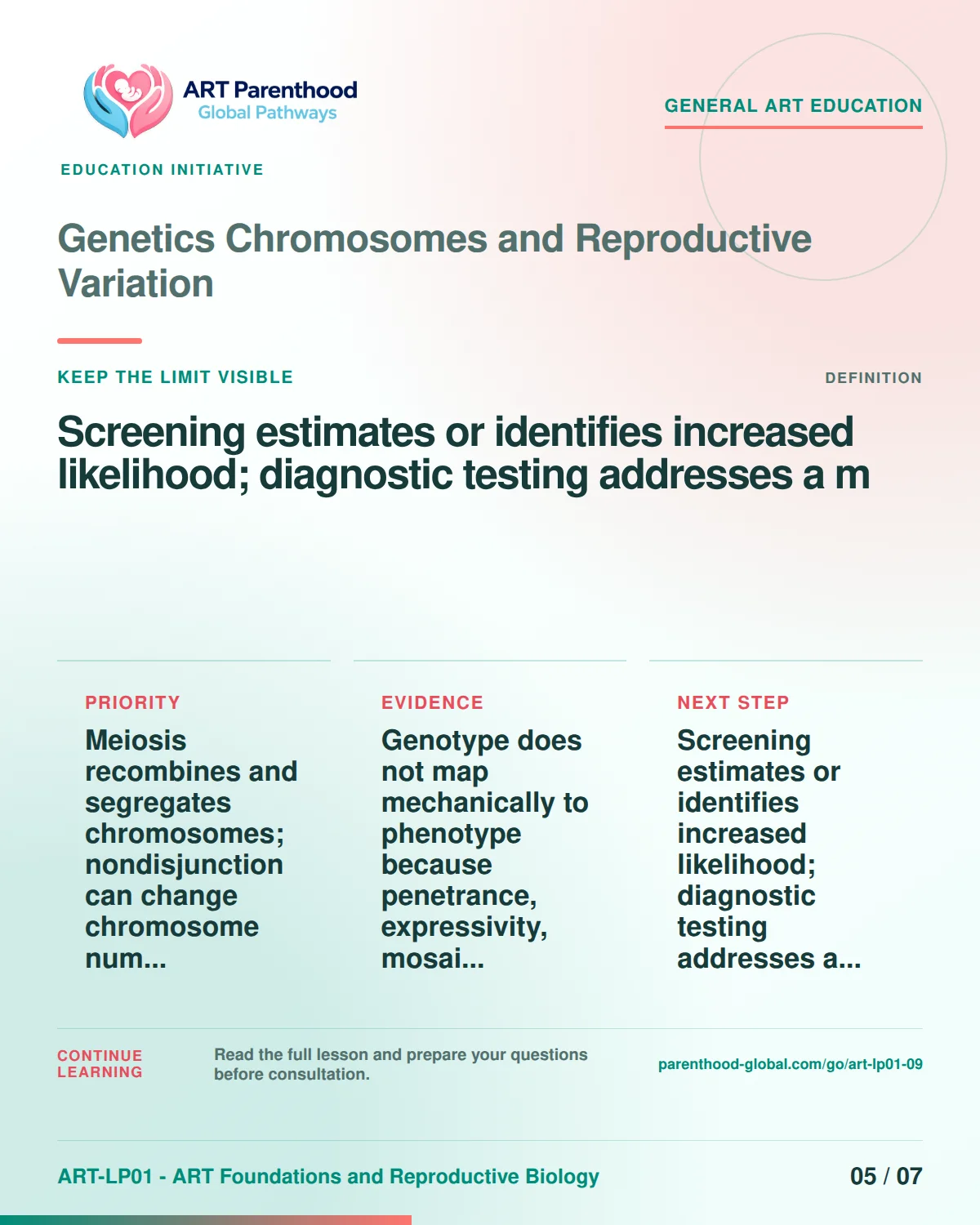
05 / 07Keep the limit visible 
06 / 07Ask the next question 
07 / 07Use the full guide
Build the functional map
DNA is packaged into chromosomes, and genes are functional sequences within that larger genome. People share most DNA but carry many variants. A variant is not automatically harmful, helpful or explanatory. Laboratories classify selected variants using population frequency, predicted effect, family segregation, functional evidence and published observations. Classification can change when evidence changes, which is why the exact gene, transcript, variant notation, laboratory, report date and current interpretation matter.
Genes are DNA sequences within chromosomes, while a variant is a difference whose meaning depends on evidence, inheritance, context and classification. Keep this observation tied to its collection time, method and biological stage; the next inference requires evidence that directly answers the clinical question. Ask whether the result is screening or diagnosis, what variant or chromosome question it covers, and what residual uncertainty requires genetic counselling.
Follow the biological sequence
Humans usually carry chromosome pairs, with one member inherited from each genetic parent. During meiosis, homologous chromosomes pair, exchange segments through recombination and segregate into gametes. Fertilization restores the paired chromosome complement. Errors in segregation can produce aneuploidy, while structural rearrangements can change dosage or chromosome organization. These mechanisms explain risk; they do not reveal the chromosome content of an individual gamete without testing.
Meiosis recombines and segregates chromosomes; nondisjunction can change chromosome number, while de novo variants can arise without family history. Keep this observation tied to its collection time, method and biological stage; the next inference requires evidence that directly answers the clinical question. Ask whether the result is screening or diagnosis, what variant or chromosome question it covers, and what residual uncertainty requires genetic counselling.
Separate observations from inferences
Inheritance patterns are probability structures, not destiny scripts. Autosomal dominant, autosomal recessive, X-linked, mitochondrial and other patterns describe how a variant may pass through a family. Penetrance describes how often a genotype is associated with a phenotype; expressivity describes variation in features or severity. A carrier result, affected diagnosis and reproductive risk estimate therefore answer different questions and require the family context and test limitations to remain visible.
Genotype does not map mechanically to phenotype because penetrance, expressivity, mosaicism, multiple genes and environment can alter outcomes. Keep this observation tied to its collection time, method and biological stage; the next inference requires evidence that directly answers the clinical question. Ask whether the result is screening or diagnosis, what variant or chromosome question it covers, and what residual uncertainty requires genetic counselling.
Connect the science to ART
De novo variants arise in a gamete or early embryo and may not appear in parental blood. Mosaicism means genetically different cell populations coexist in one person or embryo; the sampled tissue and mosaic fraction affect what a result can detect and imply. Germline mosaicism can create recurrence risk even when a parental blood test is negative. These realities prevent a negative family history or negative panel from being interpreted as zero genetic risk.
Read counts and reports precisely
Carrier screening looks for selected inherited conditions, often before or during pregnancy. It may be targeted by ancestry or family history, or use an expanded panel. Detection rate, residual risk, gene coverage and variant classes differ. A negative screen reduces risk only for the conditions and methods covered. When both genetic contributors carry variants for the same recessive condition, genetic counselling can explain reproductive options without prescribing a morally correct choice.
Know what the evidence cannot decide
Embryo and prenatal testing use different samples, methods, timings and endpoints. PGT may assess selected monogenic conditions, structural rearrangements or chromosome copy-number patterns, but a trophectoderm biopsy samples a small cell group and does not test every disease or trait. Prenatal screening estimates likelihood; chorionic-villus sampling or amniocentesis can support diagnostic analysis for defined questions. Confirmation pathways and limitations belong with every result.
Turn the map into better questions
Ethical precision matters. Genetic information can affect relatives, identity, privacy and future children, and uncertain results can generate pressure. Variant of uncertain significance should not be treated as a diagnosis. Polygenic scores aggregate many associations and can have limited transportability across ancestry groups. The useful next step is to identify the decision, request the full report, confirm current classification and use a qualified genetics professional to connect evidence with values and options.
- Genes are DNA sequences within chromosomes, while a variant is a difference whose meaning depends on evidence, inheritance, context and classification.
- Meiosis recombines and segregates chromosomes; nondisjunction can change chromosome number, while de novo variants can arise without family history.
- Genotype does not map mechanically to phenotype because penetrance, expressivity, mosaicism, multiple genes and environment can alter outcomes.
- Screening estimates or identifies increased likelihood; diagnostic testing addresses a more defined question, and neither tests every genetic condition.
For Nerds: Technical Deep Dive
Cover nondisjunction, recombination, autosomal and sex-linked inheritance, penetrance and expressivity, variant classification, mosaic fractions, polygenic complexity, and ascertainment bias.
Mechanism and feedback
Meiosis I separates homologous chromosomes after recombination, while meiosis II separates sister chromatids. Nondisjunction, premature chromatid separation or anaphase lag can produce aneuploid cells. Balanced structural rearrangements may leave a carrier healthy while generating unbalanced gametes. Recombination location and chromosome architecture influence segregation possibilities. De novo single-nucleotide variants, copy-number variants and structural changes arise through different mechanisms. A karyotype, chromosomal microarray and sequencing assay therefore view different scales and cannot be treated as interchangeable comprehensive tests. Meiosis I separates homologous chromosomes after recombination, while meiosis II separates sister chromatids. Nondisjunction, premature chromatid separation or anaphase lag can produce aneuploid cells. Balanced structural rearrangements may leave a carrier healthy while generating unbalanced gametes. Recombination location and chromosome architecture influence segregation possibilities. De novo single-nucleotide variants, copy-number variants and structural changes arise through different mechanisms. A karyotype, chromosomal microarray and sequencing assay therefore view different scales and cannot be treated as interchangeable comprehensive tests.
- Genes are DNA sequences within chromosomes, while a variant is a difference whose meaning depends on evidence, inheritance, context and classification.
- Meiosis recombines and segregates chromosomes; nondisjunction can change chromosome number, while de novo variants can arise without family history.
- Genotype does not map mechanically to phenotype because penetrance, expressivity, mosaicism, multiple genes and environment can alter outcomes.
Expected ranges / examples
- Stage-specific interpretation example: DNA -> gene -> chromosome -> variant classification. A mechanism sequence used to keep adjacent biological stages and observations from being treated as interchangeable outcomes. Source: MedlinePlus Genetics - How genes work.
What the measurement captures
Variant interpretation uses frameworks that weigh population data, computational prediction, functional studies, allelic data, segregation, phenotype match and prior reports. Categories such as pathogenic, likely pathogenic, uncertain significance, likely benign and benign describe evidence strength under stated criteria. Penetrance and expressivity complicate counselling even for pathogenic variants. Residual risk after a negative result depends on pretest probability, detection rate, genes and regions covered, variant types detectable and whether the correct familial variant was known. Variant interpretation uses frameworks that weigh population data, computational prediction, functional studies, allelic data, segregation, phenotype match and prior reports. Categories such as pathogenic, likely pathogenic, uncertain significance, likely benign and benign describe evidence strength under stated criteria. Penetrance and expressivity complicate counselling even for pathogenic variants. Residual risk after a negative result depends on pretest probability, detection rate, genes and regions covered, variant types detectable and whether the correct familial variant was known.
- Genes are DNA sequences within chromosomes, while a variant is a difference whose meaning depends on evidence, inheritance, context and classification.
- Meiosis recombines and segregates chromosomes; nondisjunction can change chromosome number, while de novo variants can arise without family history.
- Genotype does not map mechanically to phenotype because penetrance, expressivity, mosaicism, multiple genes and environment can alter outcomes.
Expected ranges / examples
- Stage-specific interpretation example: DNA -> gene -> chromosome -> variant classification. A mechanism sequence used to keep adjacent biological stages and observations from being treated as interchangeable outcomes. Source: MedlinePlus Genetics - How genes work.
Inference limits and reporting
Mosaicism makes sampling central. A trophectoderm biopsy represents sampled placental-lineage cells and can be affected by technical noise, amplification and biological mosaicism. A blood sample may not reveal gonadal or tissue-limited mosaicism. Polygenic risk scores depend on effect estimates across many loci and may lose calibration across populations. Reporting should preserve sample type, platform, resolution, quality thresholds, classification date and confirmatory recommendation. Genetic counselling owns integration of family history, phenotype, residual uncertainty, reproductive options and the individual’s values. Mosaicism makes sampling central. A trophectoderm biopsy represents sampled placental-lineage cells and can be affected by technical noise, amplification and biological mosaicism. A blood sample may not reveal gonadal or tissue-limited mosaicism. Polygenic risk scores depend on effect estimates across many loci and may lose calibration across populations. Reporting should preserve sample type, platform, resolution, quality thresholds, classification date and confirmatory recommendation. Genetic counselling owns integration of family history, phenotype, residual uncertainty, reproductive options and the individual’s values.
- Genes are DNA sequences within chromosomes, while a variant is a difference whose meaning depends on evidence, inheritance, context and classification.
- Meiosis recombines and segregates chromosomes; nondisjunction can change chromosome number, while de novo variants can arise without family history.
- Genotype does not map mechanically to phenotype because penetrance, expressivity, mosaicism, multiple genes and environment can alter outcomes.
Key takeaways
- Genes are DNA sequences within chromosomes, while a variant is a difference whose meaning depends on evidence, inheritance, context and classification.
- Meiosis recombines and segregates chromosomes; nondisjunction can change chromosome number, while de novo variants can arise without family history.
- Genotype does not map mechanically to phenotype because penetrance, expressivity, mosaicism, multiple genes and environment can alter outcomes.
- Screening estimates or identifies increased likelihood; diagnostic testing addresses a more defined question, and neither tests every genetic condition.
FAQ
What is the most important distinction in genetics, chromosomes and reproductive variation?
Genes are DNA sequences within chromosomes, while a variant is a difference whose meaning depends on evidence, inheritance, context and classification.
Can one result identify the cause or predict an outcome?
No. A result answers a defined question at a particular time and with a particular method; clinical interpretation combines it with history, examination and other evidence.
Why do counts or labels change between stages?
Each label has its own numerator, denominator and observation point. Biological attrition, sampling and measurement mean adjacent stages are related but not identical.
Does being inside a reference range prove fertility?
No. Reference intervals describe a comparison population and method; they do not establish reproductive capacity or guarantee a future outcome.
What should I ask before relying on a claim?
Ask whether the result is screening or diagnosis, what variant or chromosome question it covers, and what residual uncertainty requires genetic counselling.
Who should interpret a personal finding?
The clinician or laboratory professional responsible for that test should explain the method, timing, limits and relevance to the individual clinical question.