

ART-LP01-06 · ART-LP01
Follow the biological sequence from ovulation through fertilization and cleavage while distinguishing in-vivo events from what an IVF laboratory can observe. The useful starting point is to separate structures, processes, measurements and outcomes, then connect only the claims that biology and evidence can support.
Visual lesson summary
Review the lesson as a carousel.
Swipe or scroll through the key ideas, then continue with the detailed guidance below.

01 / 07Ovulation, Fertilization and First Cell Divisions 
02 / 07Name each stage 
03 / 07Trace the mechanism 
04 / 07Read the measure 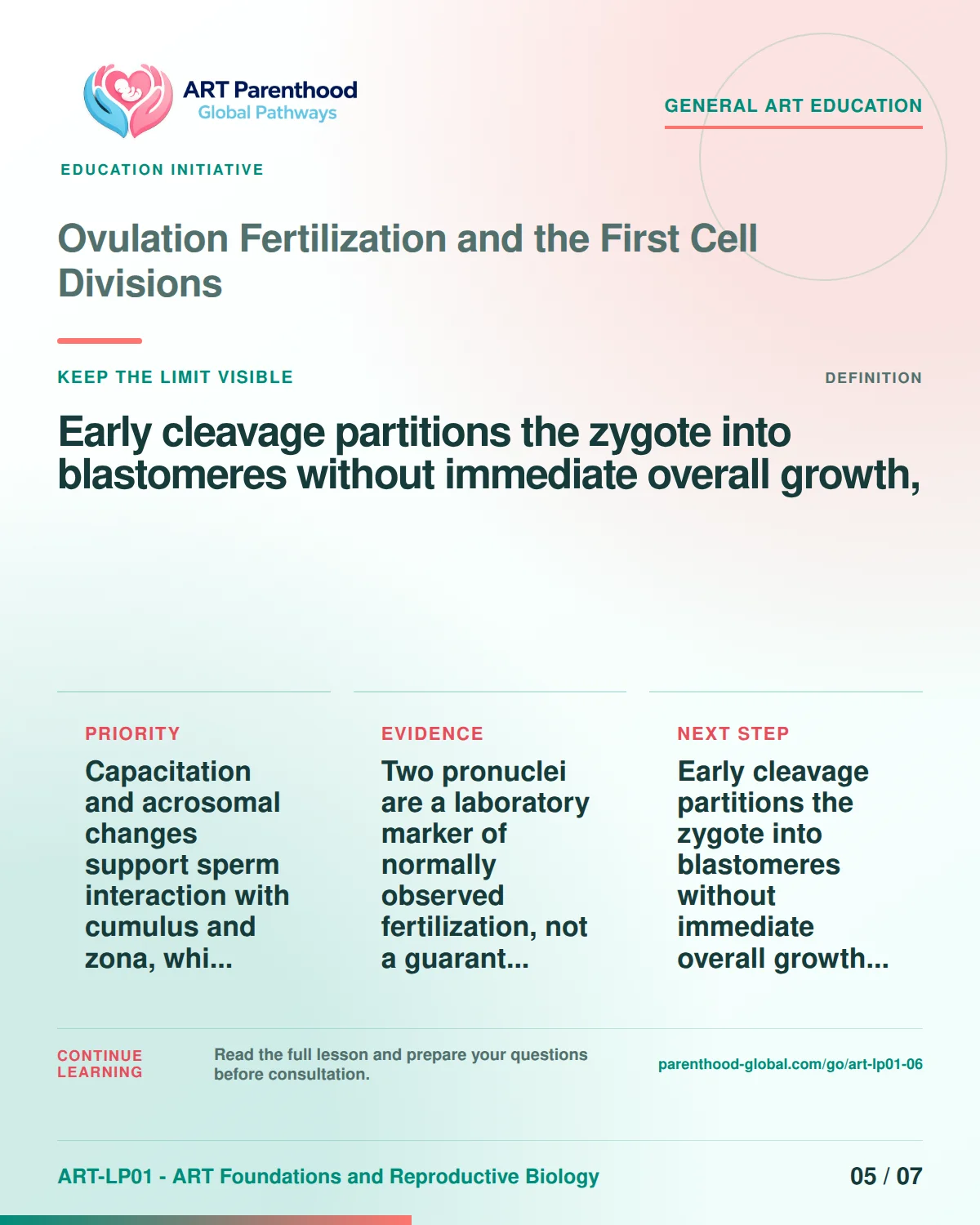
05 / 07Keep the limit visible 
06 / 07Ask the next question 
07 / 07Use the full guide
Build the functional map
Ovulation is a coordinated event rather than an egg dropping into an empty space. The cumulus-oocyte complex is released from the follicle, and fimbrial movement, tubal cilia and smooth muscle support pickup and transport. Sperm deposited in the reproductive tract must survive transport and undergo functional changes before reaching the usual fertilization region. Timing affects the chance that competent gametes meet, but a calendar estimate cannot show the exact cellular events inside one cycle.
Ovulation releases a cumulus-oocyte complex; tubal pickup and sperm transport must bring gametes together in the right interval for in-vivo fertilization. Keep this observation tied to its collection time, method and biological stage; the next inference requires evidence that directly answers the clinical question. Ask exactly which milestone was observed, when it was assessed and what later outcome remains unknown.
Follow the biological sequence
Sperm capacitation includes membrane and signalling changes that support hyperactivated movement and responsiveness near the oocyte. Interaction with cumulus cells and the zona pellucida precedes membrane fusion. The acrosomal reaction releases and exposes components involved in penetration, but the familiar idea of a single sperm simply drilling through is misleading. Fertilization depends on coordinated gamete recognition, membrane events and a competent oocyte, not speed alone.
Capacitation and acrosomal changes support sperm interaction with cumulus and zona, while oocyte activation and cortical granules help prevent polyspermy. Keep this observation tied to its collection time, method and biological stage; the next inference requires evidence that directly answers the clinical question. Ask exactly which milestone was observed, when it was assessed and what later outcome remains unknown.
Separate observations from inferences
After fusion, the oocyte activates. Calcium oscillations contribute to completion of meiosis II, extrusion of the second polar body and reorganization of maternal and paternal chromatin. Cortical granule exocytosis modifies the zona and helps block additional sperm. Failures at these checkpoints can produce absent activation or abnormal fertilization, including polyspermy. These mechanisms explain why insemination and fertilization are not synonyms and why one sperm-oocyte contact does not equal a normal zygote.
Two pronuclei are a laboratory marker of normally observed fertilization, not a guarantee of normal chromosomes or continued development. Keep this observation tied to its collection time, method and biological stage; the next inference requires evidence that directly answers the clinical question. Ask exactly which milestone was observed, when it was assessed and what later outcome remains unknown.
Connect the science to ART
In IVF laboratories, embryologists commonly assess pronuclei after insemination or ICSI. Observation of two pronuclei and expected polar bodies is used as an operational marker of normal fertilization. Timing matters because pronuclei appear and fade. A 2PN observation does not inspect every chromosome, prove syngamy was error-free or predict blastocyst formation. It records one important stage under a defined observation schedule.
Read counts and reports precisely
The first mitotic divisions produce blastomeres while the embryo remains within the zona pellucida. Overall size changes little because the cytoplasm is partitioned. Cleavage timing, blastomere symmetry, fragmentation and multinucleation may be recorded, but static checks sample a dynamic process. Human embryos show real variability, and development that looks regular can still arrest while development with an imperfect observation can continue.
Know what the evidence cannot decide
Control of early development gradually shifts from stored maternal transcripts and proteins toward embryonic genome activation. DNA replication, chromosome segregation, cell-cycle checkpoints, metabolism and organelle function must remain coordinated. Attrition between normal fertilization, cleavage and later stages is therefore biologically expected. Reporting should keep denominators visible: oocytes inseminated, mature oocytes injected, 2PN zygotes and embryos assessed are not interchangeable groups.
Turn the map into better questions
In-vivo and IVF events overlap but are not identical environments. A laboratory can observe gametes, fertilization markers and cleavage at selected times; it cannot directly observe what would have occurred in a tube, nor can early morphology reveal every mechanism. The useful interpretation is milestone-specific. Ask whether the report concerns insemination, 2PN fertilization, cleavage, morphology or continued development, and resist converting any one checkpoint into a pregnancy forecast.
- Ovulation releases a cumulus-oocyte complex; tubal pickup and sperm transport must bring gametes together in the right interval for in-vivo fertilization.
- Capacitation and acrosomal changes support sperm interaction with cumulus and zona, while oocyte activation and cortical granules help prevent polyspermy.
- Two pronuclei are a laboratory marker of normally observed fertilization, not a guarantee of normal chromosomes or continued development.
- Early cleavage partitions the zygote into blastomeres without immediate overall growth, and developmental timing is informative but not deterministic.
For Nerds: Technical Deep Dive
Include capacitation, acrosome reaction, zona binding, cortical reaction, polyspermy blocks, 2PN assessment, maternal-to-zygotic transition, and limits of static morphology checks.
Mechanism and feedback
Capacitation involves cholesterol efflux, membrane reorganization, bicarbonate and calcium signalling, protein phosphorylation and changes in motility. Hyperactivation supports movement through the cumulus and interaction near the zona. Acrosomal exocytosis is a regulated membrane event rather than a simple mechanical drill. Following sperm-oocyte fusion, phospholipase-mediated signalling contributes to repetitive calcium rises in the oocyte. Those oscillations coordinate cortical granule release, completion of meiosis II and pronuclear formation. ICSI bypasses several approach and membrane-interaction steps but still requires oocyte activation and downstream cellular competence. Capacitation involves cholesterol efflux, membrane reorganization, bicarbonate and calcium signalling, protein phosphorylation and changes in motility. Hyperactivation supports movement through the cumulus and interaction near the zona. Acrosomal exocytosis is a regulated membrane event rather than a simple mechanical drill. Following sperm-oocyte fusion, phospholipase-mediated signalling contributes to repetitive calcium rises in the oocyte. Those oscillations coordinate cortical granule release, completion of meiosis II and pronuclear formation. ICSI bypasses several approach and membrane-interaction steps but still requires oocyte activation and downstream cellular competence.
- Ovulation releases a cumulus-oocyte complex; tubal pickup and sperm transport must bring gametes together in the right interval for in-vivo fertilization.
- Capacitation and acrosomal changes support sperm interaction with cumulus and zona, while oocyte activation and cortical granules help prevent polyspermy.
- Two pronuclei are a laboratory marker of normally observed fertilization, not a guarantee of normal chromosomes or continued development.
Expected ranges / examples
- Stage-specific interpretation example: cumulus-oocyte complex -> capacitation -> acrosome reaction -> cortical granule reaction. A mechanism sequence used to keep adjacent biological stages and observations from being treated as interchangeable outcomes. Source: OpenStax Anatomy and Physiology 2e.
What the measurement captures
Pronuclear assessment is time-sensitive. Expected 2PN morphology is an operational marker of normally observed fertilization, while 0PN, 1PN or 3PN observations require context because asynchronous appearance or disappearance can complicate classification. Polar-body number adds information but is not chromosome testing. Syngamy describes parental genomes coming together for the first mitosis; it is not directly captured by a single static image. Cleavage then depends on DNA replication, centrosomal organization, spindle assembly and cytokinesis, with errors capable of producing arrest, multinucleation or mosaic cell lines. Pronuclear assessment is time-sensitive. Expected 2PN morphology is an operational marker of normally observed fertilization, while 0PN, 1PN or 3PN observations require context because asynchronous appearance or disappearance can complicate classification. Polar-body number adds information but is not chromosome testing. Syngamy describes parental genomes coming together for the first mitosis; it is not directly captured by a single static image. Cleavage then depends on DNA replication, centrosomal organization, spindle assembly and cytokinesis, with errors capable of producing arrest, multinucleation or mosaic cell lines.
- Ovulation releases a cumulus-oocyte complex; tubal pickup and sperm transport must bring gametes together in the right interval for in-vivo fertilization.
- Capacitation and acrosomal changes support sperm interaction with cumulus and zona, while oocyte activation and cortical granules help prevent polyspermy.
- Two pronuclei are a laboratory marker of normally observed fertilization, not a guarantee of normal chromosomes or continued development.
Expected ranges / examples
- Stage-specific interpretation example: cumulus-oocyte complex -> capacitation -> acrosome reaction -> cortical granule reaction. A mechanism sequence used to keep adjacent biological stages and observations from being treated as interchangeable outcomes. Source: OpenStax Anatomy and Physiology 2e.
Inference limits and reporting
Early embryo assessment is an observation system with sampling limits. Time-lapse imaging provides more temporal data than periodic checks but does not convert morphology into certainty. Algorithms trained on selected laboratory populations may not transport to another clinic, culture system or patient mix. Meaningful reports state insemination method, denominator, observation time, developmental day and endpoint. Fertilization rate, cleavage rate and usable-embryo rate answer different process questions. None is a stand-alone estimate of implantation or live birth for one embryo. Early embryo assessment is an observation system with sampling limits. Time-lapse imaging provides more temporal data than periodic checks but does not convert morphology into certainty. Algorithms trained on selected laboratory populations may not transport to another clinic, culture system or patient mix. Meaningful reports state insemination method, denominator, observation time, developmental day and endpoint. Fertilization rate, cleavage rate and usable-embryo rate answer different process questions. None is a stand-alone estimate of implantation or live birth for one embryo.
- Ovulation releases a cumulus-oocyte complex; tubal pickup and sperm transport must bring gametes together in the right interval for in-vivo fertilization.
- Capacitation and acrosomal changes support sperm interaction with cumulus and zona, while oocyte activation and cortical granules help prevent polyspermy.
- Two pronuclei are a laboratory marker of normally observed fertilization, not a guarantee of normal chromosomes or continued development.
Key takeaways
- Ovulation releases a cumulus-oocyte complex; tubal pickup and sperm transport must bring gametes together in the right interval for in-vivo fertilization.
- Capacitation and acrosomal changes support sperm interaction with cumulus and zona, while oocyte activation and cortical granules help prevent polyspermy.
- Two pronuclei are a laboratory marker of normally observed fertilization, not a guarantee of normal chromosomes or continued development.
- Early cleavage partitions the zygote into blastomeres without immediate overall growth, and developmental timing is informative but not deterministic.
FAQ
What is the most important distinction in ovulation, fertilization and first cell divisions?
Ovulation releases a cumulus-oocyte complex; tubal pickup and sperm transport must bring gametes together in the right interval for in-vivo fertilization.
Can one result identify the cause or predict an outcome?
No. A result answers a defined question at a particular time and with a particular method; clinical interpretation combines it with history, examination and other evidence.
Why do counts or labels change between stages?
Each label has its own numerator, denominator and observation point. Biological attrition, sampling and measurement mean adjacent stages are related but not identical.
Does being inside a reference range prove fertility?
No. Reference intervals describe a comparison population and method; they do not establish reproductive capacity or guarantee a future outcome.
What should I ask before relying on a claim?
Ask exactly which milestone was observed, when it was assessed and what later outcome remains unknown.
Who should interpret a personal finding?
The clinician or laboratory professional responsible for that test should explain the method, timing, limits and relevance to the individual clinical question.