

ART-LP01-02 · ART-LP01
Fertility treatment, ART, and IVF are related terms, but they do not sit at the same level of specificity. That distinction matters because public articles, clinic pages, and success-rate claims often depend on the exact process being discussed, not just the broad topic of fertility care. Once the labels are separated, it becomes easier to compare information accurately and ask better follow-up questions.
Visual lesson summary
Review the lesson as a carousel.
Swipe or scroll through the key ideas, then continue with the detailed guidance below.
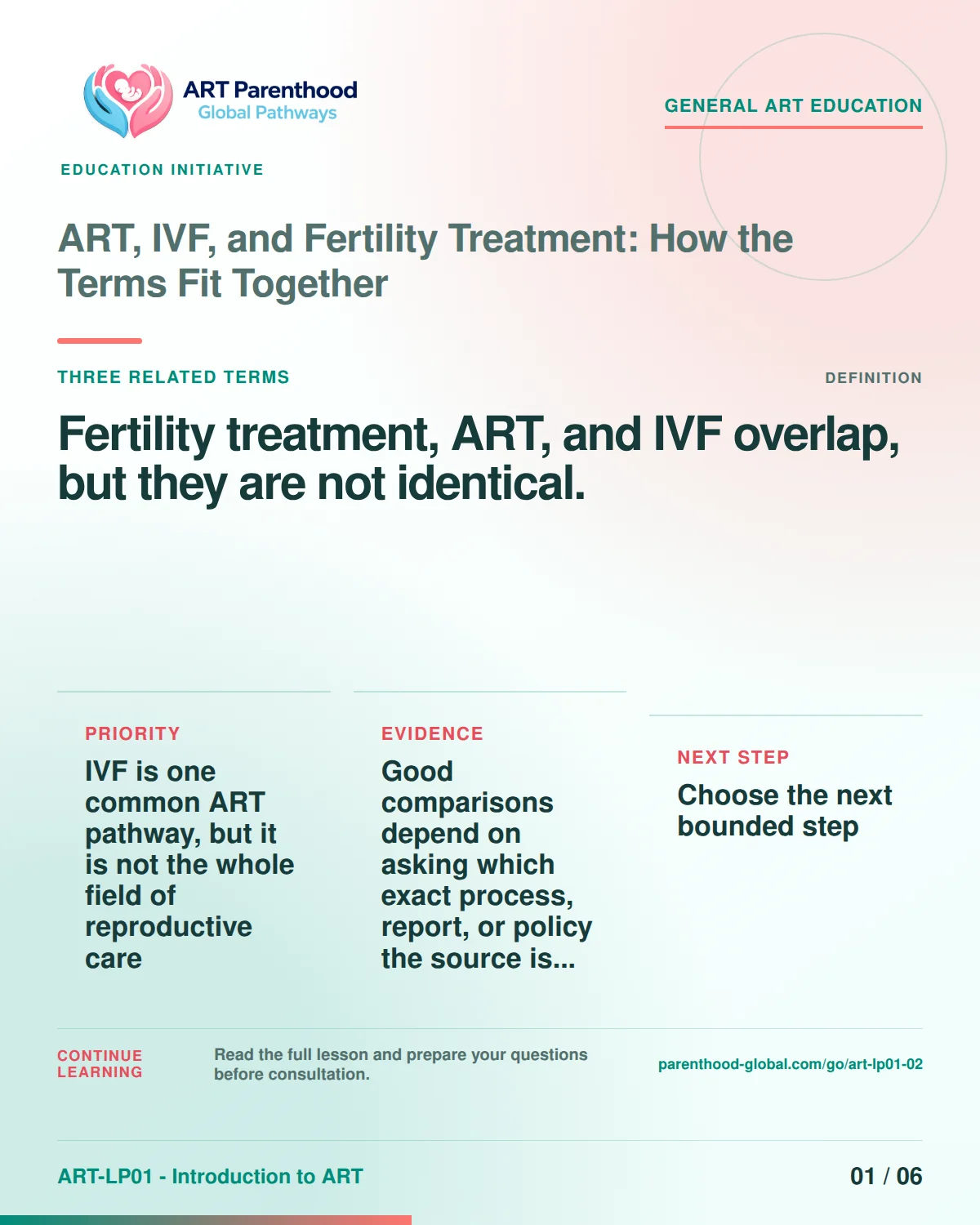
01 / 06Three related terms 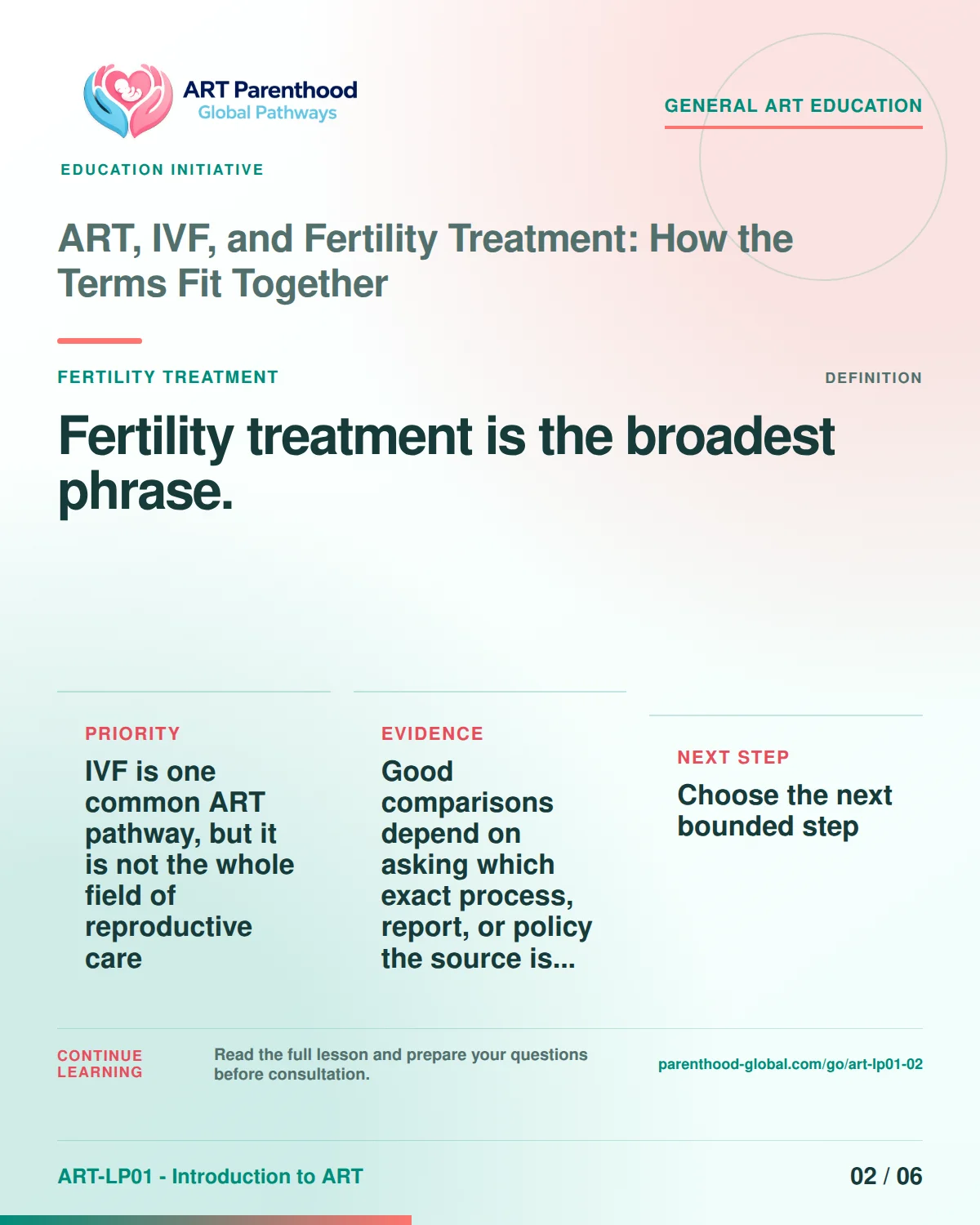
02 / 06Fertility treatment 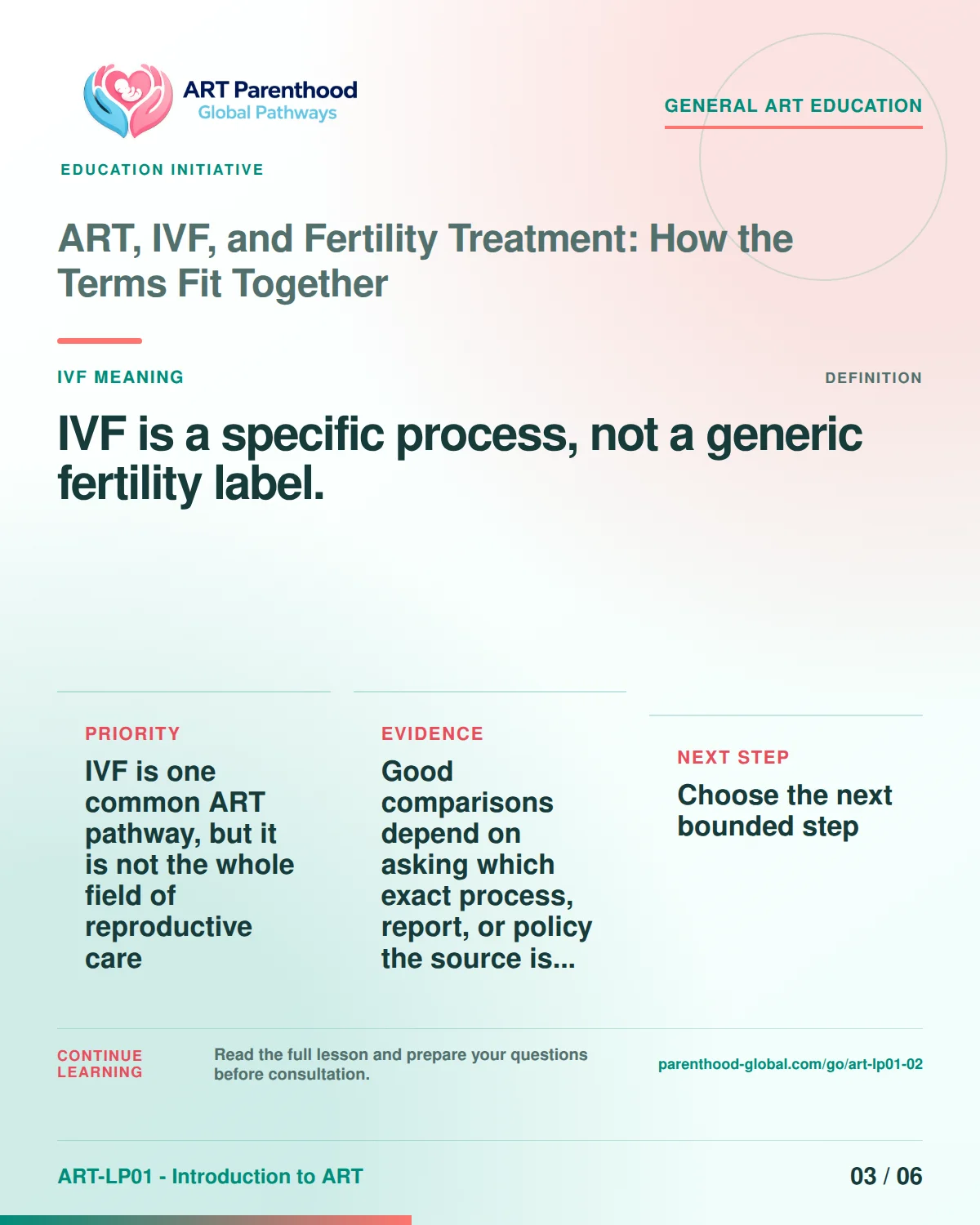
03 / 06IVF meaning 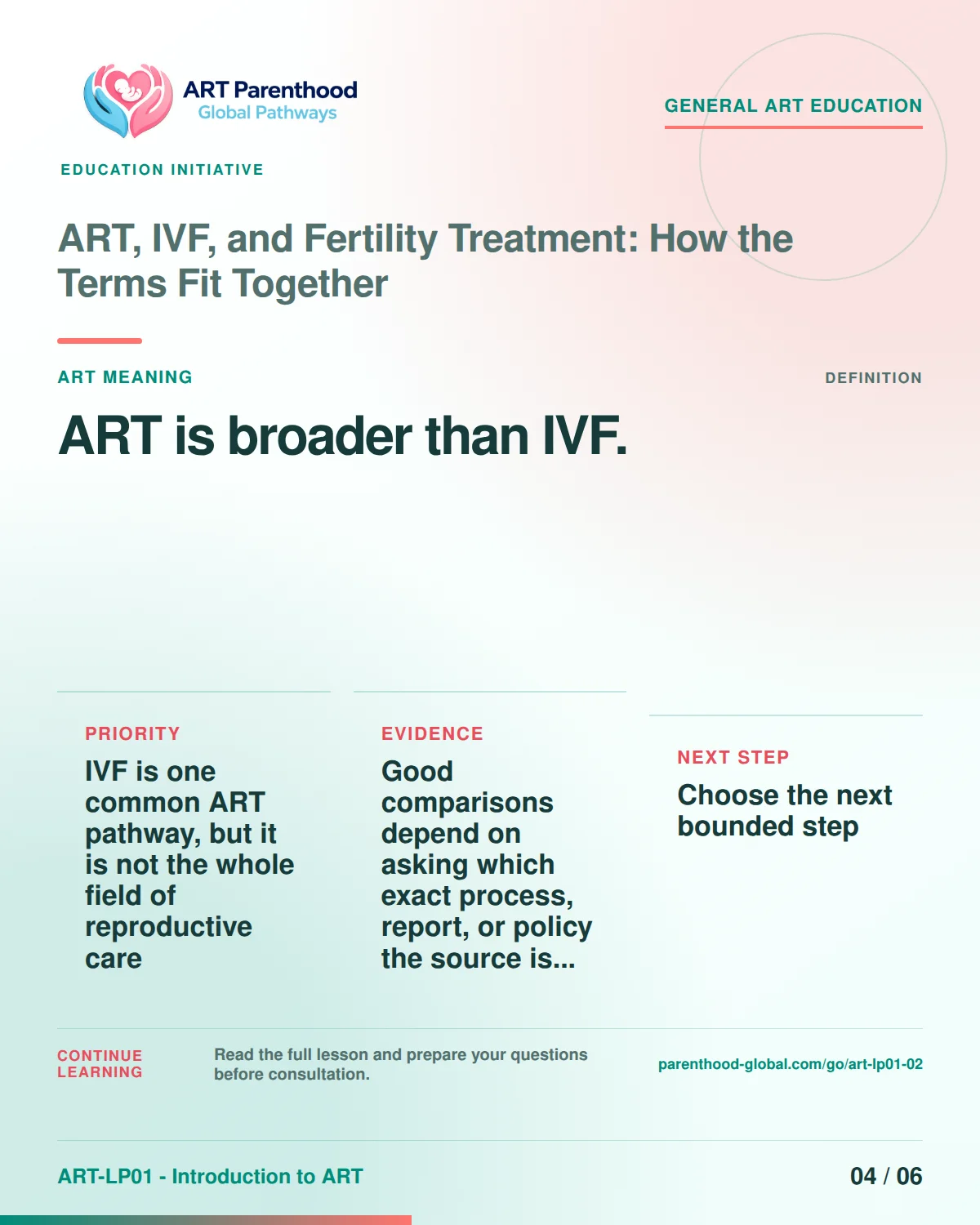
04 / 06ART meaning 
05 / 06Read sources carefully 
06 / 06Read the full guide
Start with the broadest term
Fertility treatment is the broadest phrase in this lesson. It can cover evaluation, medication, procedures, or referral-based care, so the term alone does not identify a single path.
A useful public-health reading habit is to slow down when the wording is broad. If a page says fertility treatment, the next sentence should tell you whether it means testing, medication, IVF, donor care, embryo-related work, or some other form of reproductive care.
Why the labels change the question
For a general reader, the labels matter because they change what questions should be asked next. A statistic about IVF does not automatically apply to every fertility-treatment discussion, and a policy about ART may not cover every clinic service that uses fertility-care language.
When the terms are precise, readers can compare the right kind of information. That makes it easier to notice whether a source is talking about a pathway, a laboratory method, a clinical evaluation, or a broader family-building category.
- Ask whether the source is talking about a category, a pathway, or a laboratory step.
- Check whether a success rate, policy, or eligibility rule applies to the exact process you are comparing.
- Look for the next sentence after a broad label; it usually contains the real meaning.
For Nerds: Technical Deep Dive
This advanced section helps a public reader see where broad terminology stops being useful and where more exact clinical, laboratory, and records language must take over. It treats ART as a category label, IVF as a pathway, and lab or planning terms such as ICSI, cryopreservation, embryo culture, semen analysis, AMH, and antral follicle count as different kinds of information rather than interchangeable shorthand.
Category language versus actionable detail
From a professional-review perspective, ART is a useful public category but not a complete decision tool. Once the reader moves beyond orientation, the technical questions become narrower. Is the source talking about ovarian stimulation, retrieval, insemination method, embryo culture, freezing, transfer, semen-analysis interpretation, donor screening, or a records-and-consent issue tied to another person? Each of those questions belongs to a different professional lens. IVF is one pathway. ICSI is a fertilization method that may or may not be used inside IVF. Cryopreservation is a storage step that can apply to eggs, sperm, or embryos. Embryo culture describes monitored lab development. Embryo transfer is the final placement step. These terms are related, but they are not interchangeable, and they should not be collapsed into one broad phrase when accuracy matters. The same is true for evaluation language. A semen analysis is a structured laboratory report with multiple fields, not a yes-or-no verdict. AMH and antral follicle count can support ovarian-response planning, but they do not by themselves establish egg quality or predict a single person's outcome. A careful public reader should therefore ask which exact process, report, or document is under discussion and what question that item can actually answer. That habit prevents category terms from being mistaken for clinical conclusions, and it also makes it easier to notice when a source is using broad fertility language for convenience rather than precision. In public education, the goal is not to turn readers into clinicians; it is to help them read a source with enough discipline to know when a word is only a label and when it is carrying real technical meaning.
- IVF names a pathway; it does not erase the separate meaning of fertilization method, embryo culture, freezing, transfer, or storage.
- A semen analysis or ovarian-reserve marker is part of the conversation, not the final answer by itself.
- When a source gets more precise, the reader can ask better questions about the step, report, or document being discussed.
Expected ranges / examples
- Umbrella-term example: handling eggs or embryos as part of ART care. A high-level boundary for public education, useful for category reading but not enough for pathway decisions. Source: CDC - About ART.
- Semen-analysis example fields: volume, concentration, motility, progressive motility, morphology. Standard report fields that should be interpreted with collection conditions, laboratory method, and repeat testing when needed. Source: WHO - Laboratory Manual for the Examination and Processing of Human Semen (6th ed.).
- Ovarian-reserve example markers: AMH and antral follicle count. Planning markers that can support discussion but should not be used as standalone outcome predictions. Source: ASRM - Testing and Interpreting Measures of Ovarian Reserve: A Committee Opinion (2020).
Timeline breakdown
- Orientation: The first discussion usually starts with broad terminology and the question of which process the source actually means.. A reader, patient, or reviewer identifies whether the source is referring to fertility care generally, an ART category, or a specific IVF-related step.
- Technical comparison: The next pass happens when the source needs to be compared with lab work, planning markers, or consent language.. The reader separates category language from report language, lab steps, and paperwork so that claims can be evaluated on the right level of meaning.
Key takeaways
- Fertility treatment is the broadest term.
- ART is a category, and IVF is one common pathway within it.
- Precise wording helps readers compare the right claims, policies, and statistics.
FAQ
Is ART the same as IVF?
No. IVF is one common ART pathway, but ART is a broader category that can also include other lab-based or embryo-related processes.
Is fertility treatment the same as ART?
No. Fertility treatment is the broader phrase. ART is a more specific category that usually refers to care involving eggs or embryos in a laboratory-based process.
Why does the wording matter so much?
Because the wording changes what statistics, policies, consent steps, and clinical details may apply to the claim you are reading.
Do these labels tell me which path to choose?
No. The labels help you understand the discussion, but the right path still depends on medical facts, legal context, and professional guidance.